
EMBERWARD
Tower Defence is one of the foundational genres for me. I admit that it is not a historical one - in the earliest days of gaming nobody heard of this stiff genre, it is, technically speaking, a relatively modern one. But when I was just the ripe age to get deeper into gaming, considering it a prime form of entertainment as a spry lad, it became The Thing. Mostly because it was an age of Flash games, of browser-based entertainment that could be safely accessed at school IT classes… Anyway, the point I’m trying to make is that this genre was with me since I became a certified Gamer, and so, I always looked at it fondly.
BLOONS. GEMCRAFT. PLANTS vs. ZOMBIES. Just to name a few titans of this niche genre, they were always perfect games to sink countless hours into despite their very static nature. I am not surprised that this was, possibly, one of the first Entry Genres for a vast number of burgeoning developers. Nowadays we have Survivor-likes as the testing ground for newfound game makers, but back in the day it was TD that was the most accessible one to craft, exactly due to it’s almost boardgame’ish qualities. You don’t have to worry about dynamic movements, physics, often not even about third dimension! A grid, set of numbers-clad ‘towers’ that fit the theme of your game, waves of enemies and done, Bob’s your uncle!
All that prelude to just tell you that EMBERWARD is possibly one of the best examples of the genre I ever played.
One can ask, why though. It’s not like there’s much innovation left here to discover, right? We had tower defence games of every flavour imaginable, mixed and crossbred with every genre under the sun. First person shooters mixed in, RTS’s, RPG’s, you name it! And yet EMBERWARD becomes a top dog of this niche by not experimenting with stuff that is completely unique but rather doing the things that you’d expect from this kind of game to the highest possible caliber of mastery.
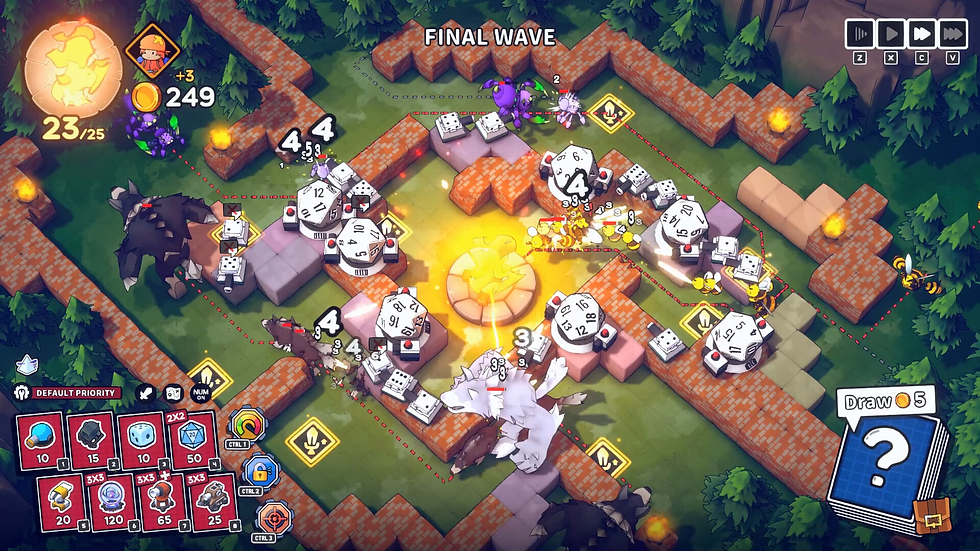
There are SO many systems here that I feel I shouldn’t even attempt to write about all of them, least the review becomes a very dry checklist of things the game has to offer. But I will give you the highlights, or rather, a little walkthrough the process of setting stuff down to hopefully illustrate what makes this game a peerless example of a tower defence done exceptionally right.
When a stage starts the first step is to use my collection of TETRIS-inspired pieces to tighten the maze. Monstrous invaders have a very easy beeline down to my hearth, and it is up to me to craft a labyrinth of corridors to make the approach time consuming and dangerous. Forging the gauntlet. The blocks, of course, is also where I’ll be placing my selection of towers. Some of the towers are bigger and I’ll need to make sure to create spaces for them to be placed. But Lo! And Behold! The blocks I lay down can acquire runes which modify a single block on the shape to provide variety of bonuses - empowered damage, range, critical chance, improved elemental damage and many more!
And then the mind rapidly clicks that I can align multiple blocks with said bonuses nearby with a bit of clever planning with a dash of risk versus reward tossed in, just so later in the stage I can place that 2x2 Tower with 4 bonuses - greatly increasing its damage, rate of fire, range… or whatever else I managed to scrounge up! Sure, cumulating blocks that way might mean I am not making the maze longer, but I trust the investment in super-powered tower will make up for that weakness, right?

Then, of course, I need a build. I do not have access to every tower in the game, oh no, far from it! Each run you start with a semi-randomized selection of three that will, to some minor degree, decide your game plan. You can hyperfocus on single element, for example. They all have their strengths and weaknesses. Shock is fantastic at stunning big monsters and giving your other weapons ample time to shave them down. Poison can stack enormous damage, but ticks down slowly. Chill enables crits and slows down the hordes. And so on! It’s always something neat, and of course going hard into just one is one of the possible tactics. It is good to mix 2 or 3, or even go full hog as you unlock your towers loadout and get a healthy mix of elemental statuses to aid in your defence.
That’s another part of what makes EMBERWARD so delightful to play - there are no boring towers. Not only each of the structures have 2 different upgrades to pick from, often imbuing or changing their damage with a new elemental, but they are all strange, wacky and unique. DICE towers that you can reroll to change their fire rate or damage. Barrage broadside lines that get stronger the more you link them in a long line and bombard a more distant lane. Automated hammers that smack down a very small area in front of them but compensate that rigidity with huge damage numbers. Drone deploying towers, bubble-chucking towers, lava-spilling towers… There’s a hefty selection of them to play with and they are all great fun to figure out some unique synergies with.
And then there’s the depth of content. You have different characters to play with, each offering unique set of abilities that greatly modify your run. Your hearth, the very fire you protect, can also change, being empowered with some unique abilities to help your plan out. There are roguelike relics here, powerful items that can hugely impact your builds and play, rewarding your hyper-focusing on a singular element or allowing for some combos to trigger strong, impactful effects. Cards and spells to temporarily boost up your towers. Meta-progression skills that, slowly as you grind through the campaign levels, grant you more options, better starting position, stronger hearth, bonuses of wide variety to help you craft a build with less reliance on randomness to smile your way.

And then the levels themselves! They have a great progression of difficulty, always introducing new, thematic mechanics depending on where you are. The bosses are each a unique challenge; each biome has a different selection of enemies with unique behaviours. As well as different traps and features. Cold winds in snowy stage that slow or speed up monster waves. Freezing your blocks to render them useless after a few rounds. Traps that you can maze around to force the monsters to walk through them. Conduits of energies to activate powerful machineries… There’s always something extra to think about, some level mechanic to figure out for your benefit, and they are never something you can just easily discard out of mind. Or do so at your own peril!
Even that wouldn’t be all. There are different game modes, multiple difficulties, unlockables, modified stages with corruptions or anomalies… A wide range of stuff to have fun with. And it is FUN! Pure glee when your little engine of deadly towers mangles, shreds and obliterated big waves. Cold dread when you see something nasty push through your gauntlet, and you smash pause hard only to realize that there is no total time-stop, but a huge bullet-time, in which you can spend your dosh to solidify your defences before big baddies stifle out your flame… It’s a perfect blend of problem-solving puzzles and thrill of a flashy display of assorted weaponry going ham onto the invading hordes.
I recommend EMBERWARD. It is, by far, one of the best Tower Defence games I played, ever. I’ll be first to admit that it doesn’t do anything to reinvent the genre, there are no bold new ideas here that make my brain go ‘Woaw!’. And so, it is not a mind-boggling masterpiece… But if you’re a TD fan, this one is a must in your library. And if you never was a big enjoyer of placing towers, or you didn’t play one of these in a long time… Well, I would still very much recommend this game as a perfect example of how much of a good time this genre can be.



Comments