
MONSTER TRAIN 2
It takes a certain reckless bravery - or perhaps a complete disregard for one’s sanity - to venture into the world and declare, “Yes, I shall make a roguelike deckbuilder!” Not because it’s hard (it is, painfully so), but because in the indie scene it’s one of the most wrung-out, milked-dry, overpopulated genres this side of the multiverse. Search that exact tag on Steam and you’ll get over 800 titles - enough to last you several lifetimes, assuming you never sleep, have no job, and subsist entirely on Doritos and Mountain Dew.
And yet, sheer quantity isn’t even your biggest problem. No, the real challenge is that a few megaton juggernauts have already claimed the genre’s throne. Trying to dethrone them? That’s like showing up at the Olympics with a pogo stick and demanding a gold medal in the high jump. In this day and age, good luck going toe-to-toe with SLAY THE SPIRE or BALATRO.
But maybe - maybe - you’ve got an ace up your sleeve. Say, for instance, you’re the mad geniuses behind MONSTER TRAIN, one of those shining “best of the best” examples that keep popping up in every “Top 5 Deckbuilders” list from every self-proclaimed gaming guru. That means you’ve got the skills, the experience, the magic recipe — the secret sauce. Even so, you’ve still got one more terrifying opponent to face: yourself.
Because here’s the thing: when your first game gets showered with critical acclaim, glowing reviews, and fan devotion, how on earth do you top it? How do you make something more perfect than what’s already been declared perfect? That was the Everest staring down Monster Train 2: a fight in a market so oversaturated it’s practically drowning, a fight against its own predecessor, and a battle against fervent fans who demanded something “just like the first one… but different, and better in every way” without having the faintest idea what that means.
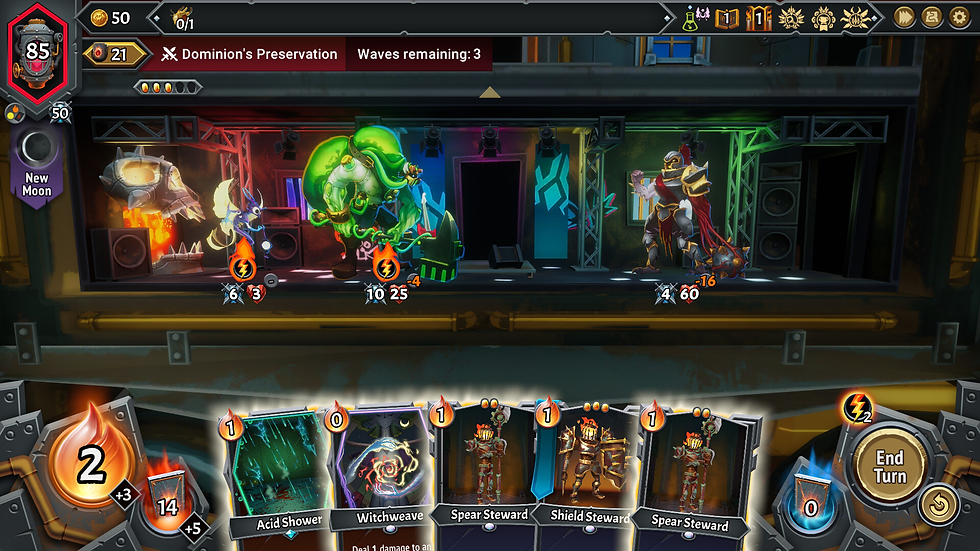
And you know what?
MONSTER TRAIN 2 delivered. By every conceivable metric, it’s the superior game. In my eyes, it’s not just the best sequel - it’s the best roguelike deckbuilder ever made. So suck it, Slay the Spire. Time for your sequel to try to beat not only your own legend, but also this shiny new king of the deck-building adventures!
I don’t want to go into the nitty-gritty of game mechanics. That stuff always reads like the world’s driest instruction manual, or worse, the back-of-the-box blurb written by a poor intern who just wanted to go home. “It’s a deck-builder!” Well, yeah. You know what that means. Cards! Choices! Probably some overpowered boss waiting to smack you around! And yes, we’ve got the usual suspects: branching paths, shiny relics, card upgrades, and bosses that demand a good thrashing.
So instead, let’s ask the real question: what makes a roguelike deck-builder good?
First thing that leaps to mind: choices. Delicious, overwhelming, “I spent 10 minutes deciding between two cards and regret everything” kinds of choices. If a deck-builder only gives you a sad little pile of cards and the same bland strategy every run, that’s not a game - it’s a chore. Where’s the builder part of the fun? Choices are the spice, the zest, the hot sauce! The more the merrier. And on that note, MONSTER TRAIN 2 doesn’t just deliver - it’s a buffet that never ends. With 10 clans, each rocking two unique champions, you’ve got a smorgasbord of playstyles. And since you always pick two clans per run, you’re mixing and matching like a mad scientist at a card-crafting convention. I’m not great at math, but the number of possible combinations is somewhere around 200? That's huge.

Now, having options is nice, but they need to feel different. Because what’s the point of having a billion cards if they all just boil down to “deal damage, but slightly spicier”? No, no, no - variety without flavor is like a sandwich without condiments. And this game delivers on that, too. The clans are wildly distinct. Some focus on brute-force offense, some on sneaky spell slinging, others on a slow, grindy war of attrition. Even within a single clan, your champion changes everything. Take the Pyreborn dragons: Lord Fenix is all about stacking the clan's unique status effect, while Lady Gilda is like, “nah, let’s just chuck a swarm of cheap units, milk their glorious deaths for value, and get filthy rich doing it.” Different vibes, same clan, totally new experience. Every run feels fresh, like opening a mystery box where the mystery isn’t tedious routine.
And then, of course, there’s the magic word: balance. Nothing kills enthusiasm faster than realizing your favorite faction is the weakest link, a shoehorned filler with no distinct flavor or power to enjoy. Luckily, MONSTER TRAIN 2 dodges that tragedy. Every clan feels viable. I’ve taken all of them to victory on the highest difficulty, and each win felt earned, not pity-handed. That’s a rare feat in this genre. With this many possible combos, the fact that they all work is kind of miraculous. Seriously, some game designer deserves a medal, or at least an endless supply of coffee for this achievement.
And finally, what really keeps me going in games like this would be the X-Factor. The explosiveness, the potential to break the game in half over a knee like Bane did to Batman. That beautiful moment when stars align, relics roll, upgrades click, and you form the ultimate weapon, that, yes, might surpass even Metal Gear. When you create a brutal combo that obliterates the screens or murderize a boss before he has a chance to open his mouth and yap at you. When you see numbers go up, and your indestructible super-unit sporting 1500 attack power with 900 HP, halving all incoming damage, and also blessed with Trample, to roll over a row of enemies in a single smack. Or when you get deadly spells coming in for free, letting you clean shop every turn like smooth clockwork. There is plenty of that, here, a promise, a potential that if the stars align and you make the right decisions, you too can create a true monster of a deck. A steamroller that will squash any challenge the game can toss at you, and take you deep into the Endless mode, too, after you smash the regular run to smithereens.

Those are the moments of deck-building bliss. The dragon we chase when indulging in this genre. When our little machine of destruction is fully polished and chugging along smoothly. But even then, a good game will have a few tricks up its sleeve to keep you on your toes. A well-designed challenge is never one that can be easily trivialized, after all. Here we have 10 levels of ramping difficulty, and they are very cleverly designed, because they aren't merely a shoddy 'let's make enemies into damage sponges and make them hit harder'. No, instead, they offer different modifiers to mess with the smoothness of your approach. They add bloat cards to your deck to mess with your draws. They remove a breather empty wave before a boss for you to set up. They make merchants' re-rolls and purges more expensive, to reduce your options. It's a very good system that makes the challenge growth feel organic, seamless.
To be honest, even now, I have barely scratched the surface of the options the game gives you. I didn't mention that your heart, your core that you must protect and act as your run's life, also comes in a great variety, offering different stats and abilities. That if you want a customized challenge or a more leisurely attempt, you can add mutators from a very generous list of wacky modifiers. There's an additional challenge mode called Dimensional Portal, which offers a pre-set combination of clans, champions, and mutators to test yourself in varied scenarios. And of course daily challenge, so you can keep playing fresh bits of fun even after you smash through the main game offering over and over again.
There’s just always something new to try in MONSTER TRAIN 2. Whether you’re chasing that perfect run, goofing off with weird modifiers, or steadily filling out the in-game Library of unlocks, it’s the kind of game that makes you go, “Okay, just one more run” - and then you look up and realize it’s 3 a.m. Again.
MONSTER TRAIN 2 isn’t just a great sequel - it’s the new monarch of roguelike deck-builders, and it wears the crown with ease. In a genre drowning with pretenders, this game doesn’t just stand tall, it towers. With a staggering variety of clans, champions, and playstyles, ingenious balance across hundreds of permutations, and that addictive X-Factor where your deck snowballs into a glorious, game-breaking engine of chaos, it delivers the purest form of deck-building bliss. Layer on its clever difficulty scaling, lots of modifiers and challenges, and you’ve got a game that feels limitless. MONSTER TRAIN 2 doesn’t merely compete with the titans like SLAY THE SPIRE - it dethrones them. A masterpiece of the genre, and the new king of the roguelike deck-building realm.


Comments